First Half of 2025, January to May
Wednesday, May 21, 2025
Opening Social Time: 6:30 p.m.
Dinner is served: 7:00 p.m.
Speaker Presentation: About 8:00 p.m.
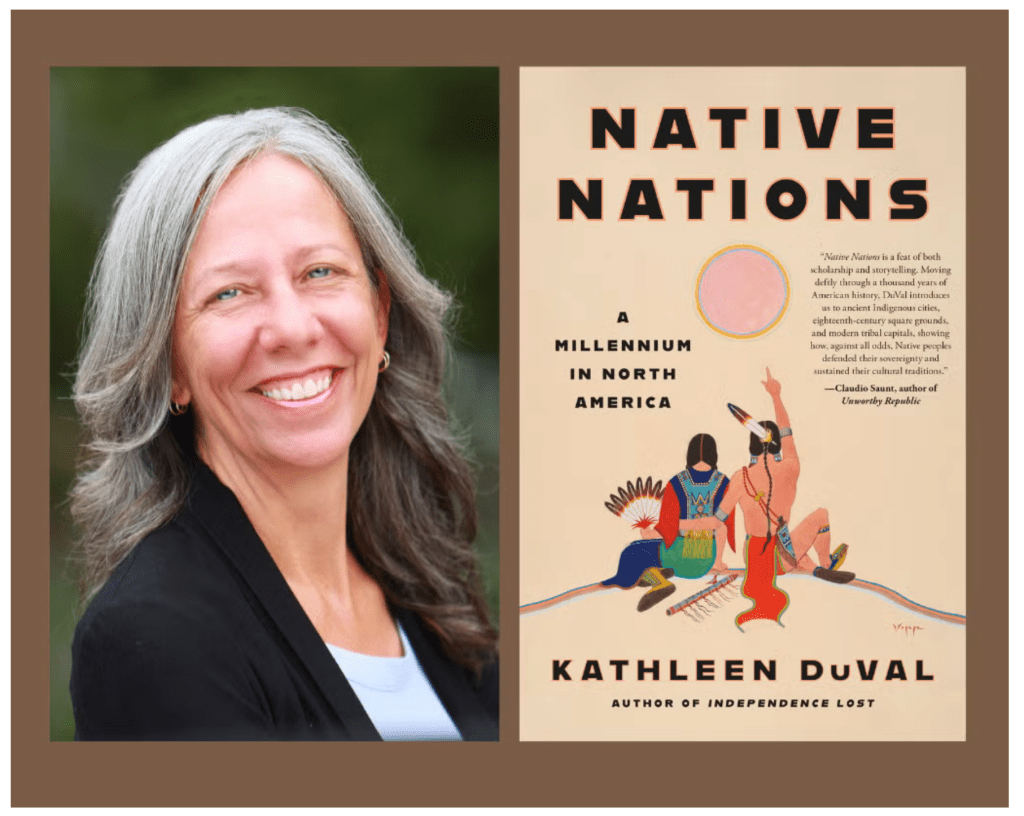
Speaker: Kathleen DuVal, Professor
Presentation Topic:
Bio Sketch:
DuVal is a professor of history, where she teaches early American and American Indian history. Her previous work includes Independence Lost: Lives on the Edge of the American Revolution, which was a finalist for the George Washington Prize.
Kathleen DuVal (FFP ’13, ’22), distinguished professor of history, has been awarded both the Bancroft Prize and the Cundill Prize for her latest book, Native Nations: A Millennium in North America. The Wall Street Journal calls Native Nations “an essential American history … DuVal fuses a millennium of Native American history into a thought-provoking, persuasive whole.” Kirkus Review’s starred review calls it “a revelatory account of the power and influence of Indigenous peoples in North America.” Publisher’s Weekly also gave it a starred review, and The Atlantic recently published an excerpt from the book. The book offers a comprehensive narrative of North American history. DuVal’s meticulous research and engaging storytelling shows how Indigenous people lived prior to European arrival, challenging the idea that the defeat of Indigenous people was inevitable. Native Nations emphasizes Indigenous people and their resilience and continued cultural vitality.
The Bancroft Prize, administered by Columbia University, is one of the most prestigious among scholars of American history and honors “scope, significance, depth of research and richness of interpretation.”
The Cundill Prize, awarded by McGill University, is the largest award for a book of non-fiction in English. The prize is awarded to a work of outstanding history writing and is open to books from anywhere in the world.
Kathleen DuVal specializes in the interactions among Native American, European, and African populations from the 16th through early 19th centuries and has taught courses related to her research in Native Nations.
In May 2024, the College of Arts and Sciences featured Native Nations in their Bookmark This series. DuVal answers questions about the book below.
Q: Can you give us a brief synopsis of your book?
A: Native American nations existed in North America long before the coming of Europeans, and they still are here today. My book tells a millennium of this history, from around the year 1000, when North American cities rivaled urban centers around the world in size. Then, following a period of climate change and instability, numerous smaller nations emerged. Egalitarian government structures, diplomacy and complex economies spread across North America. So, when Europeans showed up in the 16th century, they encountered societies they did not understand — those having developed differently from their own — and whose power they often underestimated. For centuries afterward, Indigenous people maintained an upper hand and used Europeans in pursuit of their own interests. Power dynamics shifted dramatically after the American Revolution, but the sovereignty and influence of Native peoples remained a constant — and will continue far into the future.
Past Meetings
Wednesday, April 16, 2025
Opening Social Time: 6:30 p.m.
Dinner is served: 7:00 p.m.
Speaker Presentation: About 8:00 p.m.
Speaker: Charlie Dunlap, J.D., Professor of the Practice, Duke Law
Presentation Topic: Current Issues in National Security
Bio Sketch: (Source: Abbreviated from Internet sources)
Charles J. Dunlap Jr. joined the Duke Law faculty in July 2010 where he is currently a professor of the practice of law and Executive Director of the Center on Law, Ethics and National Security. His teaching and scholarly writing focus on national security, law of armed conflict, the use of force under international law, civil-military relations, cyberwar, airpower, military justice, and ethical issues related to the practice of national security law.
Dunlap retired from the Air Force in June 2010, having attained the rank of major general during a 34-year career in the Judge Advocate General Corps. In his capacity as Deputy Judge Advocate General spanning from May 2006 to March 2010, he assisted the Judge Advocate General in the professional supervision of more than 2,200 judge advocates, 350 civilian lawyers, 1,400 enlisted paralegals, and 500 civilians around the world. In addition to overseeing an array of military justice, operational, international, and civil law functions, he provided legal advice to commanders and civilian leaders at all levels.
A prolific author and accomplished public speaker, Dunlap’s commentary on a wide variety of national security topics has been published in leading newspapers and military journals. His 2001 essay written for Harvard University’s Carr Center on “lawfare,” a concept he defines as “the use or misuse of law as a substitute for traditional military means to accomplish an operational objective,” has been highly influential among military scholars and in the broader legal academy.
Dunlap is also the author of the prize-winning essay, “The Origins of the Military Coup of 2012”, originally published in 1992, which was selected for the 40th Anniversary Edition of Parameters (Winter 2010-2011).
Dunlap’s legal scholarship has been published in the Stanford Law Review; the Yale Journal of International Affairs; Harvard Law’s National Security Journal; the Wake Forest Law Review; the Fletcher Forum of World Affairs; the University of Nebraska Law Review; the Texas Tech Law Review; Temple Law’s Journal of International & Comparative Law; the University of North Carolina’s Journal of International Law; the Connecticut Law Review; the Tennessee Law Review; and the Vanderbilt Journal of Transnational Law; among others.
He’s also authored numerous articles and opinion pieces in a range of publications including The Atlantic, the New York Times, the Washington Post, the Washington Times, the Air Force Times, Strategic Studies Quarterly, the Georgetown Journal of International Affairs, Business Insider, the Journal of Genocide Research, The Hill, Small Wars Journal, and the blogs, Lawfare and Just Security.
Maj Gen Dunlap founded his blog Lawfire in 2015 and has since written over 400 posts on a wide variety of subjects.
He has been the recipient of numerous awards including the Brigadier General Malham M. Wakin, USAF (Ret.) Founders Award for lifetime achievement by the International Society for Military Ethics (2022).
His military decorations include the Distinguished Service Medal; the Defense Superior Service Medal (two awards); the Legion of Merit (two awards); Meritorious Service Medal (five awards); the Global War on Terrorism Medal; the Humanitarian Service Medal; and the Small Arms Expert Marksmanship Ribbon.
Dunlap’s wife, Joy, was a vice president of the National Association of Broadcasters, and later a deputy director of Government Relations for the Military Officers Association of America. She served as the elected president of Duke Campus Club and is a recipient of the prestigious Order of the Emerald by Kappa Delta sorority. Her blog, Speaking Joyfully, won 3rd place in the blog category at the 2021 Blue Ridge Mountains Christian Writers Conference. They reside in Durham.
Wednesday March 19, 2025
Opening Social Time: 6:30 p.m.
Dinner is served: 7:00 p.m.
Speaker Presentation: About 8:00 p.m.
Speaker: Professor Brian Silliman
Professor Brian Silliman, Director of Duke University Wetland and Coasts Center and a world renowned Coastal Marine Wetland Ecologist
Presentation topic: Sea Rescue, Harnessing Biological Partnerships to Restore Marine Ecosystems
Brief Biographical Information:
Brian Silliman is the Rachel Carson Distinguished Professor of Marine Conservation Biology. He holds both B.A. and M.S. degrees from the University of Virginia and completed his Ph.D. in Ecology and Evolutionary Biology at Brown University. In recognition of his research achievements, Silliman was named a Fellow of the Ecological Society of America in 2023, Distinguished Fulbright Chair with CSIRO in 2019; a Fellow of the American Association for the Advancement of Sciences in 2015; a Visiting Professor with the Royal Netherlands Society of Arts and Sciences in 2011; and David H. Smith Conservation Fellow with The Nature Conservancy in 2004. He has also received several awards, including the Young Investigator Award from the American Society of Naturalists (2006), a Young Investigator Grant Award from the Andrew Mellon Foundation (2007), and an NSF Career Grant Award (2011). Dr. Silliman has published 25 book chapters and over 200 peer-reviewed journal articles, and co-edited five books: Marine Community Ecology and Conservation, Marine Ecosystem Restoration: Challenges and New Horizons, Human Impacts on Salt Marshes: A Global Perspective, Effective Conservation: Data not Dogma, and Marine Disease Ecology. His teaching and research are focused on community ecology, food webs, conservation and restoration, global change, and evolution and ecological consequences of cooperative behavior.
Wednesday February 26, 2025
Jim Cox, Program Chair, Introducing the Speaker
Opening Social Time: 6:30 p.m.
Dinner: 7:00 p.m.
Speaker Presentation: 8:00 p.m.
Speaker: Dr. David Durack, Consulting Professor of Medicine, Duke, Club Member
Presentation Title: “Whatever happened to Mad Cow Disease?”
Brief Biographical Information: (Source: LinkedIn)
Dr. David T Durack is Consulting Professor of Medicine at Duke University, and was Senior Vice President, Corporate Medical Affairs and Chief Medical Officer at Becton Dickinson & Co (retired). Medical school: University of West Australia ’69; Postgraduate studies: Oxford University ’70 -’73 (Rhodes Scholar); Doctor of Philosophy ’73. His research has centered on host-parasite interactions and chemotherapy of bacterial and fungal infections. For 17 years he was Chief of the Division of Infectious Diseases and International Health at Duke University. He is a Fellow of the Royal College of Physicians (UK), the Royal Australasian College of Physicians, and the American College of Physicians; he has published more than 200 articles and textbook chapters and co-edited several textbooks. Dr. Durack has been elected to the American Society for Clinical Investigation, the Council of the Infectious Diseases Society of America, and the American Academy of Microbiology. He has served on an FDA Review Panel, the Joint Commission Resources Board of Directors, and as Chairman of the Board of Directors, ASM Resources Inc.; he currently consults to the healthcare industry and serves on the Board of Directors of PixelEXX.
Wednesday, January 15, 2025
Caroline Whitson, Introducing the Speaker
Opening Social Time: 6:30 p.m.
Speaker Presentation: 7:00 p.m.
Speaker: Professor Jim Cox, Brainerd Currie Professor of Law, Duke, Member of Torch Club
Presentation Focus: Headwinds for Efficient Price Discovery
Secondary securities markets, e.g., the New York Stock Exchange or Nasdaq, play an important role in the allocation of resources, e.g., commodities, human capital, and of course cash, throughout economies around the world. This occurs through a process variously named but generally referred to as “price discovery” which occurs via trading within markets. Research in the 60s and 70s repeatedly supported findings that America’s established securities markets were efficient. My talk does not necessarily challenge this conclusion, but at least place claims of market efficiency in perspective, namely the belief (which I share) that markets that are generally efficient must address three headwind forces presented by three distinct phenomenon: The growing use of passive investment strategies, algorithmic trading, and growing presence of irrational investor behavior.
Brief biographical information
James D. Cox, Brainerd Currie Professor of Law. B.S. 1966, Arizona State University; J.D. 1969, University of California San Francisco, College of the Law; LL.M. 1971, Harvard University. Professor Cox is a native of Kansas. He entered law teaching as a fellow at Boston University and has since taught at the University of San Francisco, Stanford, and the University of California, Hastings College of the Law, before coming to Duke in 1979. He has focused his writing and teaching in the areas of corporate and securities law and is the author of a book on the utilization of financial information in the regulation of public corporations, a multi-volume treatise on corporate law (4th Ed. 2024), and casebooks on securities regulations (10th ed. 2022) and business organizations (13th ed. 2024). He spent the spring of 1989 as a senior Fulbright research fellow at the University of Sydney. He was a former member of the New York Stock Exchange Legal Advisory Committee, the NASD Legal Advisory Board, the ABA Committee on Corporate Laws, the ABA Committee of Corporate Laws, the California Corporations, Committee, the Drafting Committee for N.C. Corporations and Non-Profit Corporation, and the Standing Advisory Group of the Public Company Accounting Oversight Board. He was the draftsman for the capital market laws of the Kingdom of Saudi Arabia. In 2001, Professor Cox was awarded an Honorary Doctorate of Mercature from the University of South Denmark.
 Durham-Chapel Hill Torch Club