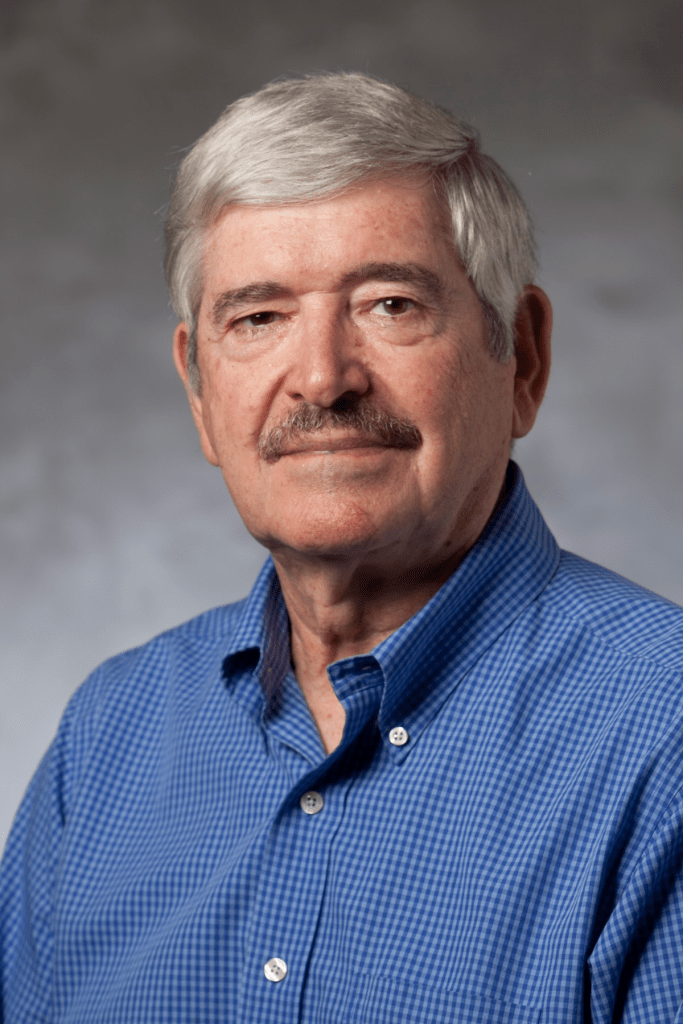
Curtis Richardson and his wife Carol moved to Durham in 1978. He left the University of Michigan faculty and took an ecology faculty position in the School of Forestry and Environmental studies, which later became the School of the Environment. He was the John O. Blackburn Distinguished Professor of Resource Ecology, and former Chair of the Division of Environmental Science and Policy in the Nicholas School of the Environment at Duke University until 2021. He is currently Research Professor of Resource Ecology. He was the founding Director of the Duke University Wetland Center in 1990 in the Nicholas School of the Environment where he taught wetland ecology, biogeochemistry and ecosystem restoration for 45 years.
His research for the past two decades has focused on wetland phosphorus cycling in the Everglades, carbon sequestration, GHG and climate change effects of restoration in Pocosin peatlands in coastal North Carolina. In 2003-2005 he worked in Iraq on water quality and marsh restoration projects for the USAID. He was elected President of the International Society of Wetland Scientists in 1987-88. He is the current head of the US International Peat Society. He has authored over > 200 Publications and several books, including “The Everglades Experiments: Lessons for Restoration” by springer-Verlag.
In 2006, he received the National Wetlands Science Award from the Environmental Law Institute in Washington DC. He has served as a scientific advisor to EPA, USAID, USDA, and USACE. He is a Fellow of the Society of Wetland Scientists, the Soil Science Society of America, and the American Association for the Advancement of Science. He was awarded an honorary Doctor of Science in 2018 by the University of Waterloo in Canada. He served for 12 years on the board of the Durham Soil and water district. He currently serves on the executive boards of the Carolina Wetlands Association and the Durham Sports Club.
 Durham-Chapel Hill Torch Club